











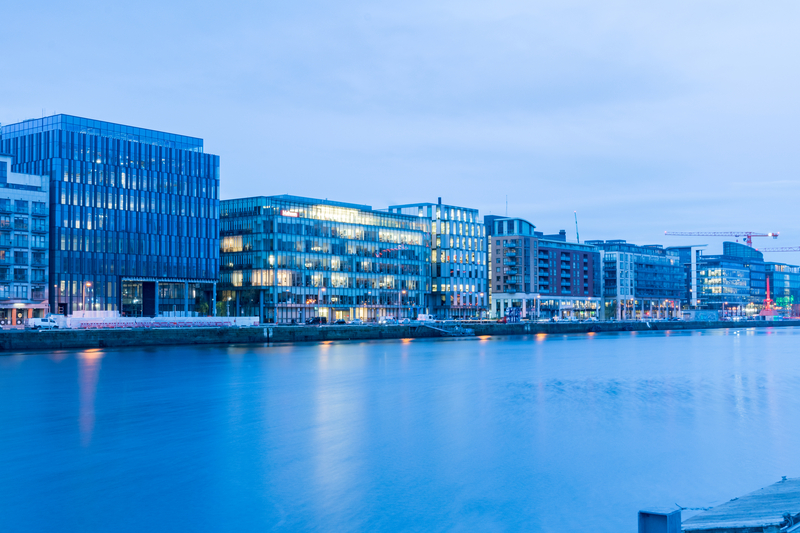
A new report from the Chartered Institute of Building (CIOB) addresses a growing paradox in Ireland, where 14.5% of office buildings were vacant in 2024 – the highest level on record – while at the same time, more than 80% of people say they are concerned about a lack of housing in their cities.
It calls for rule changes to make office buildings adaptable so that, instead of facing demolition when vacancies rise, they can be turned into much-needed homes.
The issue is particularly acute for Dublin, which had the highest office vacancy rate (15.7%) of any major European city in 2024.

Continent-wide housing crisis
The report – Building Adaptably: How the construction sector can future proof Irish cities – comes as the EU faces up to a continent-wide housing crisis, with protesters hitting the streets in a number of cities over the issue.
It appointed a designated Housing Commissioner for the first time in December last year.
The Commissioner, Dan Jørgensen, formerly a Danish minister for climate and energy, said last week that the European Commission will try to tackle the crisis by easing state aid restrictions so countries can spend state funds on social housing.
Building what we need?
A CIOB survey found that more than four fifths (81%) of people in Ireland and Northern Ireland said they were concerned about a lack of housing in their cities, and more than half (52%) said they feel stuck in their current home owing to a lack of alternatives.
Nearly two thirds (64%) said they don’t believe new construction is delivering what their city needs, and over half (52.5%) said their area has an issue with a surplus of offices.
Converting isn’t easy
Since the Covid-19 pandemic, it’s estimated that 58% of office workers now spend more time away from the office than they do in it, leading many companies to downsize.
But many vacant buildings are unsuitable for residential conversion because they have low ceilings, load-bearing internal walls, and heating, ventilation and power systems that aren’t appropriate or that make changing internal layouts too difficult.
The report says these problems could have been avoided if adaptability requirements had been in place when they were built.
It adds that building adaptability is also environmentally sustainable as it avoids the need to demolish and rebuild, which reduces the embodied carbon footprint of the construction sector.
Failure of speculative building
“The clear concerns amongst Irish and Northern Irish people over the lack of housing options in the very places where office vacancy rates are highest suggests a significant failure of the speculative building model to meet real demand,” said Joseph Kilroy, CIOB policy and public affairs manager for Ireland and author of the report.
“More than 80% have real concerns about the housing situation so it’s high time changes in how we build are made.
“In our view, the best way to achieve that change is to introduce adaptability metrics into the planning permission decision-making process. London, Paris and Amsterdam have each implemented such policies, thereby creating a potential new stream of future housing supply. The reforms we are suggesting would enable buildings to evolve alongside the societies they serve, converting underused assets into homes and communities rather than waste.”
What to do?
The report has four recommendations.
It calls for for requiring adaptability assessments at the planning stage so new buildings are designed with future change in mind.
Developers of large-scale commercial or residential projects should be asked to include renovation and conversion scenarios in their design proposals at the planning application stage, it says.
It recommends offering developers tangible incentives, such as expedited planning approval for those who adopt modular, demountable, and circular designs and construction methods.
Finally, the report urges embedding design-for-adaptability criteria in public land sales and procurement contracts to ensure publicly funded or facilitated developments are future-proofed for changing uses.
‘System struggles to deliver’
“For some time now, it has been clear that the Irish housing system struggles to deliver adequate housing supply and that the wider real estate sector, in particular office space, is highly volatile,” said Dr Michael Byrne, lecturer in social policy at University College Dublin.
“We also know that the role of housing in meeting our climate responsibilities is ‘the elephant in the room’ when it comes to housing policy debate.
“This report puts forward a compelling case for adaptability as a key concept and practice that simultaneously addresses all of these concerns. The report provides practical recommendations that have the potential to increase the supply of housing, enable the housing system and built environment to adapt to social conditions, and reduce the housing system’s carbon footprint.”
Download the report here.
- Subscribe here to get stories about construction around the world in your inbox three times a week
See also: