



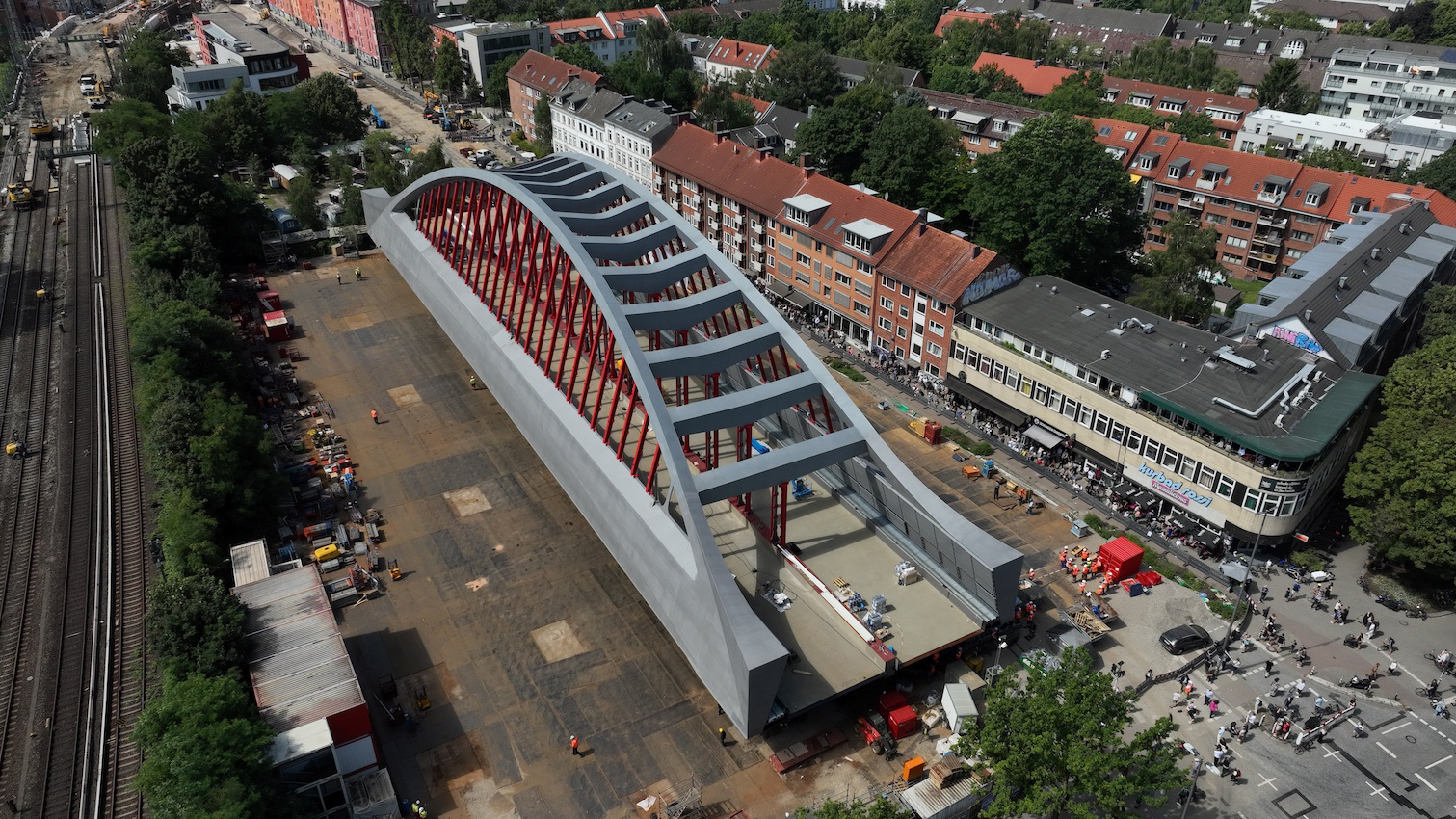
Heavy-lift specialist Mammoet has released photographs of a remarkable operation, years in planning, to install a major bridge in Hamburg in under 24 hours.
Assembling the new 3,700-tonne Sternbrücke bridge over 14 months nearby and rolling it into place in under a day avoided closing a crucial traffic artery for years in Germany’s second city, which would have resulted had the bridge been built conventionally in situ. Instead, the route was closed for just six weeks.

The Sternbrücke is a railway bridge used by around 1,000 long-distance, regional and commuter trains every day. It also serves two main roads, the Stresemannstraße and Max-Brauer-Allee, which carry tens of thousands of vehicles daily.
With the old bridge reaching the end of its design life, the decision was taken to replace the bridge with a new one instead.
Mammoet was commissioned in 2017 to carry out a feasibility study for installing the new bridge in one piece using a transport solution.
When the bridge design was revised, Mammoet determined the maximum width and height it could be for transporting on the Max-Brauer-Allee.
With the final revision of the study completed in 2023, Mammoet began putting its plan into action, ready for the bridge launch in August 2026.
“We visited the site and performed several 3D scans of the area and the full transportation route,” said Jamie Groeneweg, lead engineer at Mammoet. “By entering this data into our 3D engineering platform Move3D, we knew how narrow it was going to get and what space we had to work with. From there, we could plan accordingly.”
14 months to assemble
The bridge sections were brought to Hamburg and assembled in a laydown area beside the Max-Brauer-Allee over 14 months.
A particular challenge was the limited work area for both the assembly of the bridge sections and the mobilisation of Mammoet’s transport equipment. Around 30,000 cars use the Max-Brauer-Allee every day.
This meant a just-in-time approach was needed to bring everything to site in the correct order.
“This was our biggest challenge: the logistics and organisation of our equipment inside a very small area,” said Lars de Haas, project manager at Mammoet.
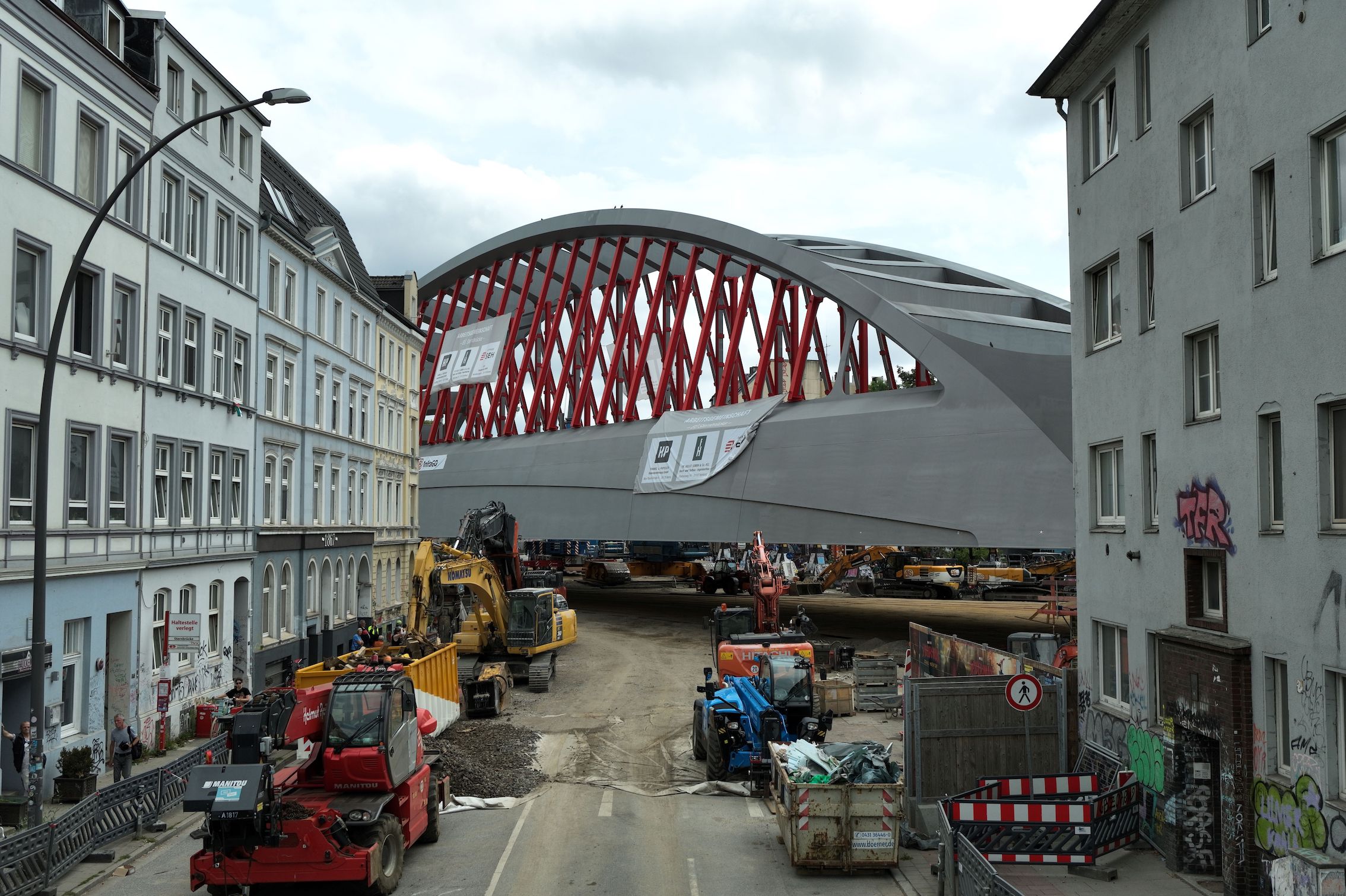
“Had we set up our trailers beside the bridge, it would have taken up all the space available and meant we wouldn’t have a laydown area. Anything arriving would immediately have to be assembled. There was a lot of work to ensure everything arrived just in time and in the correct order.”
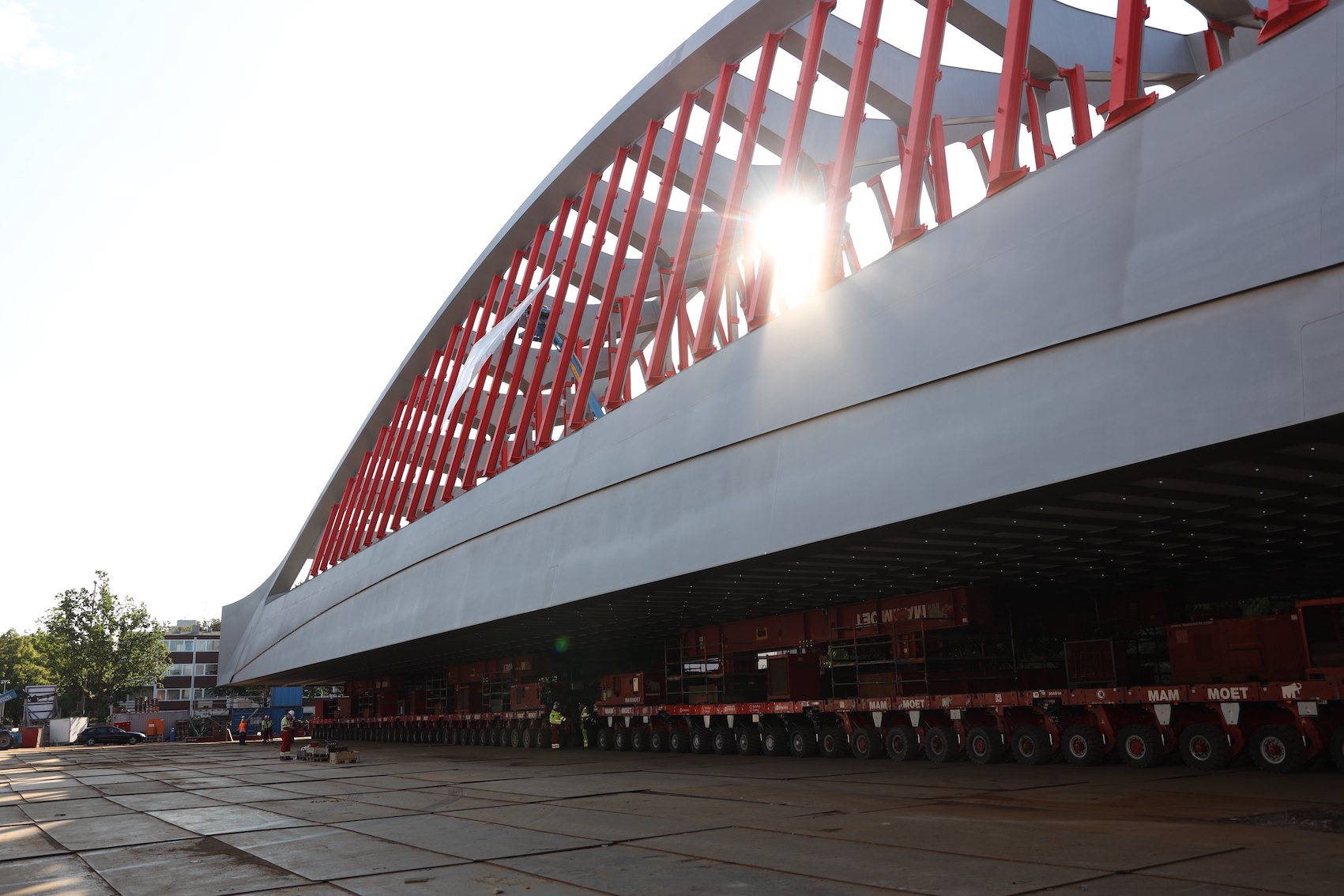
To move the assembled bridge, Mammoet used two configurations of its self-propelled modular transporters (SPMTs), each consisting of four trains, with a combined total of 272 axle lines with 16 500-tonne climbing jacks to perform the lifts.
As space was so tight, the SPMTs were assembled in two stages. Once the first configuration was assembled using a mobile crane, the bridge was jacked up from 2m to 4.5m to allow the SPMTs to be positioned underneath.
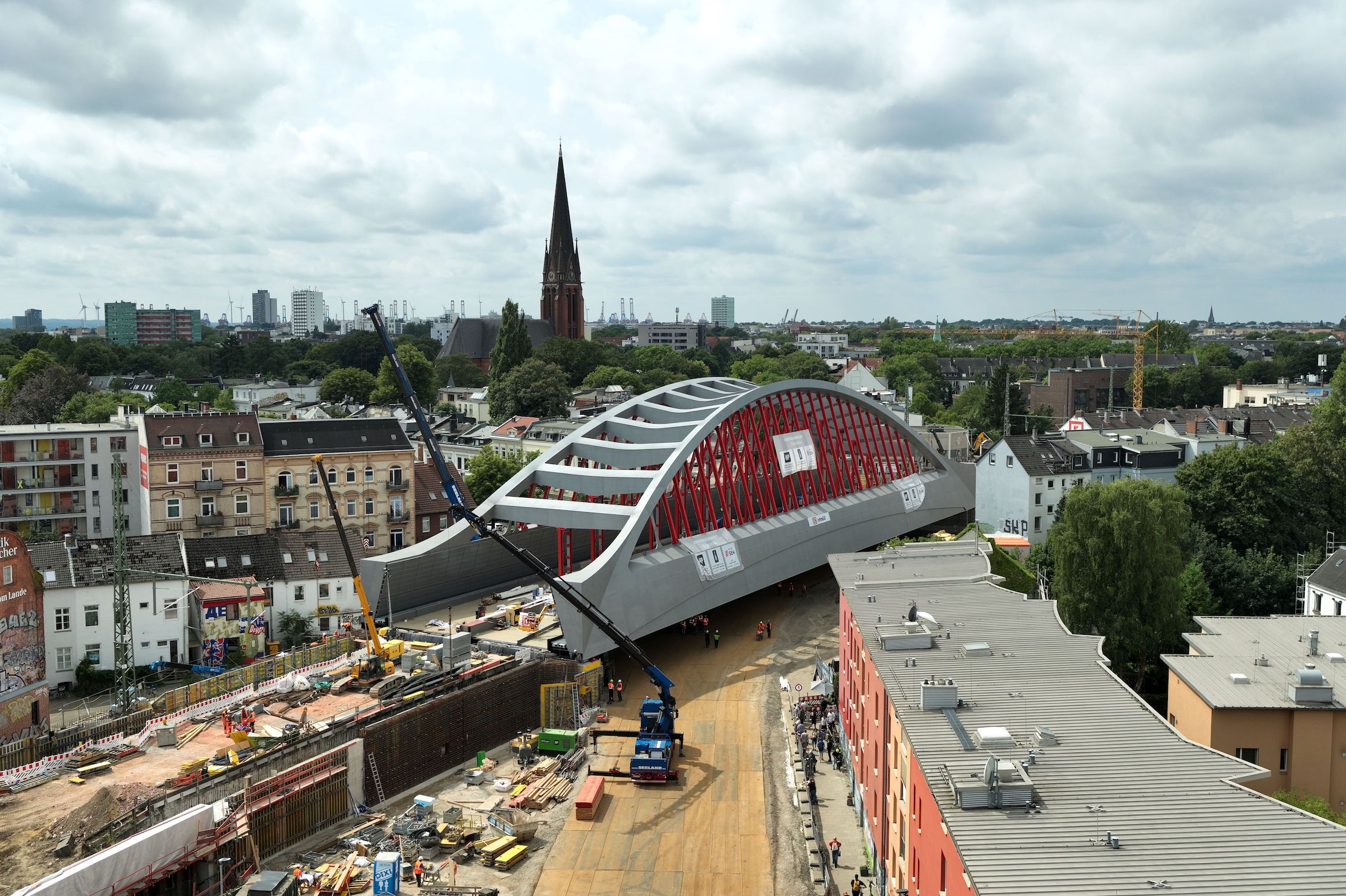
The next SPMT configuration followed and, once all the SPMTs were in position and had taken the full weight of the bridge, they were driven sideways onto the Max-Brauer-Allee, which had been specially prepared for the transport.
The road allowed a second jack-up operation of another 1.5m, which was needed to clear the new abutments before the bridge could be lowered into its final position.
Very tight squeeze
On the big day, the bridge was driven 500 meters down the Max-Brauer-Allee to its final position, where it was turned 45 degrees using the SPMTs and then jacked down 1.8m.
The road trip was extremely tight, in places with only 30cm to clear the buildings on either side of the street.
The new Sternbrücke bridge reopened on 31 August 2026 after six weeks of closure instead of years.
“I’ve been working for Mammoet now for over 15 years, and this is one of the highlights of my career,” said lead engineer Jamie Groeneweg.
“It might not be the heaviest, nor the largest bridge we’ve moved, but it certainly had a big impact. So yes, for me, it was a special moment”.
Subscribe to our newsletter here to receive construction news and insights from around the world straight to your inbox