














A Swiss researcher has developed a printable concrete-like material that is bound together by bacteria rather than cement.
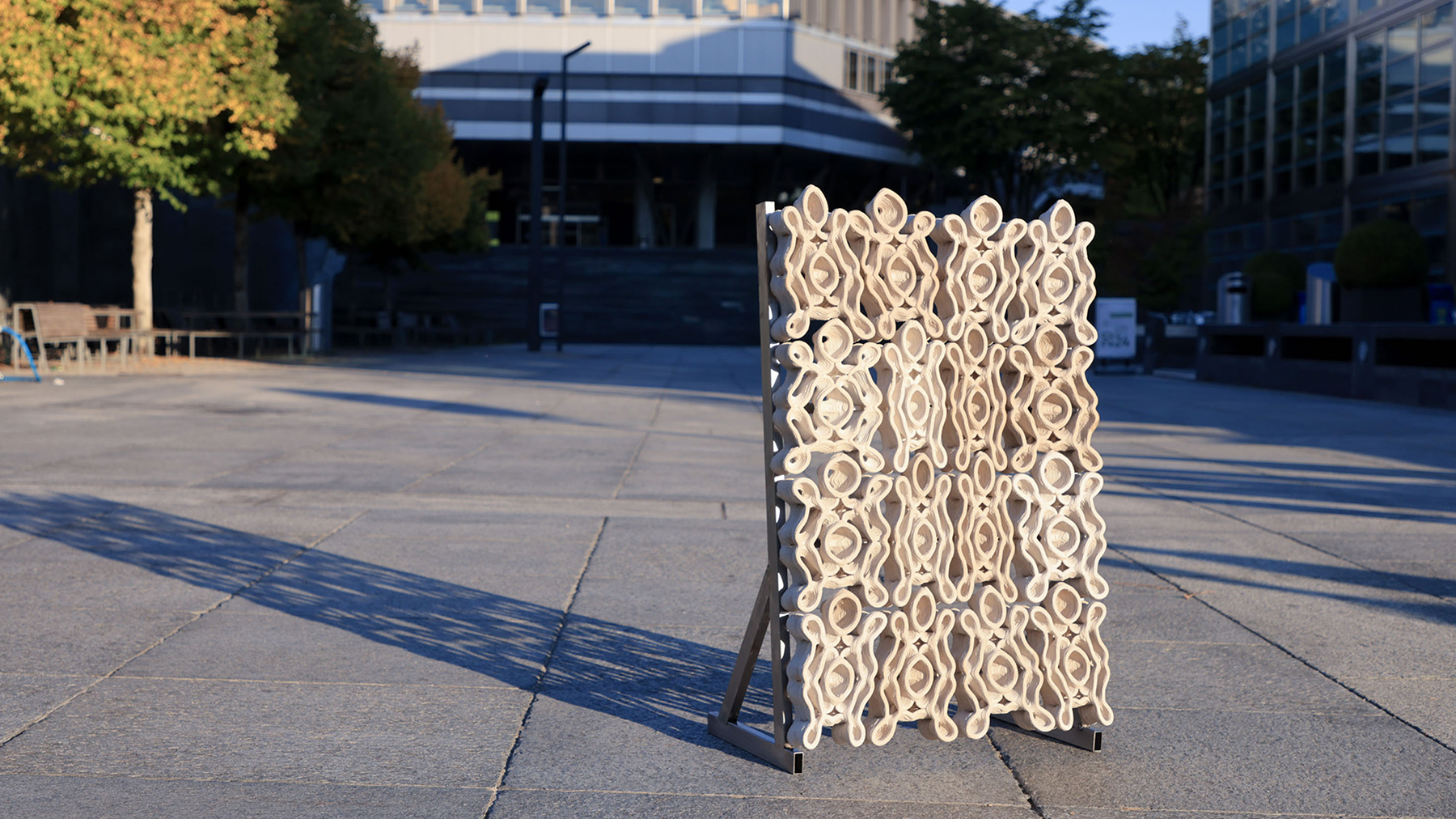
Karen Antorveza Paez developed the process while completing her doctorate at the Department of Architecture at ETH Zurich and has used it to make several architectural elements. More research is needed to make the material load-bearing.

The bacteria, Sporosarcina pasteurii, bonds sand and other grains together into a solid material by forming calcium carbonate, the mineral that makes up limestone. No heating is required, which raises the possibility of avoiding the emissions produced in making cement at some point in the future.
The process, known as biocementation, has previously been used to stabilise soils and in self-healing concrete.
When bacteria are combined with sand or other solid grains, they join the particles together into a solid structure made of interlocking, microscopic calcite crystals.
“We’re using bacteria to produce a sort of mineral glue”, said Antorveza Paez.
Two ways of making biogenic building materials
She developed two different manufacturing methods. In the first, the team developed a “bio-ink” made of a gel based on water and naturally occurring alginate and xanthan, as well as sand and live bacteria. The gel is printed into the desired form and then immersed in a bath containing urea and calcium chloride.
This is where the bacteria start their work by breaking down the urea with an enzyme called urease. The reaction releases carbonate ions and, as a by-product, ammonium. The carbonate and calcium chloride in the solution bond together to form calcium carbonate, also known as limestone, the same mineral that makes up seashells.
Microscopic crystals form between the grains of sand and interlock with each other.
‘Like baking a cake’
The entire process takes two to five days, depending on the desired strength of the architectural component.
It involves providing a fresh mineralisation bath every day. The object is then left to dry, deactivating the bacteria and leaving a solid structure.
“It’s a bit like baking a cake. You’ve got the dough, which is still very malleable and delicate. Only the oven can turn it into something solid,” Antorveza Paez said, noting that the bacteria play the role of the oven.
This process has been used to create a facade element, among other things. It can also be used to build shade structures or partition walls.
Robotic spraying
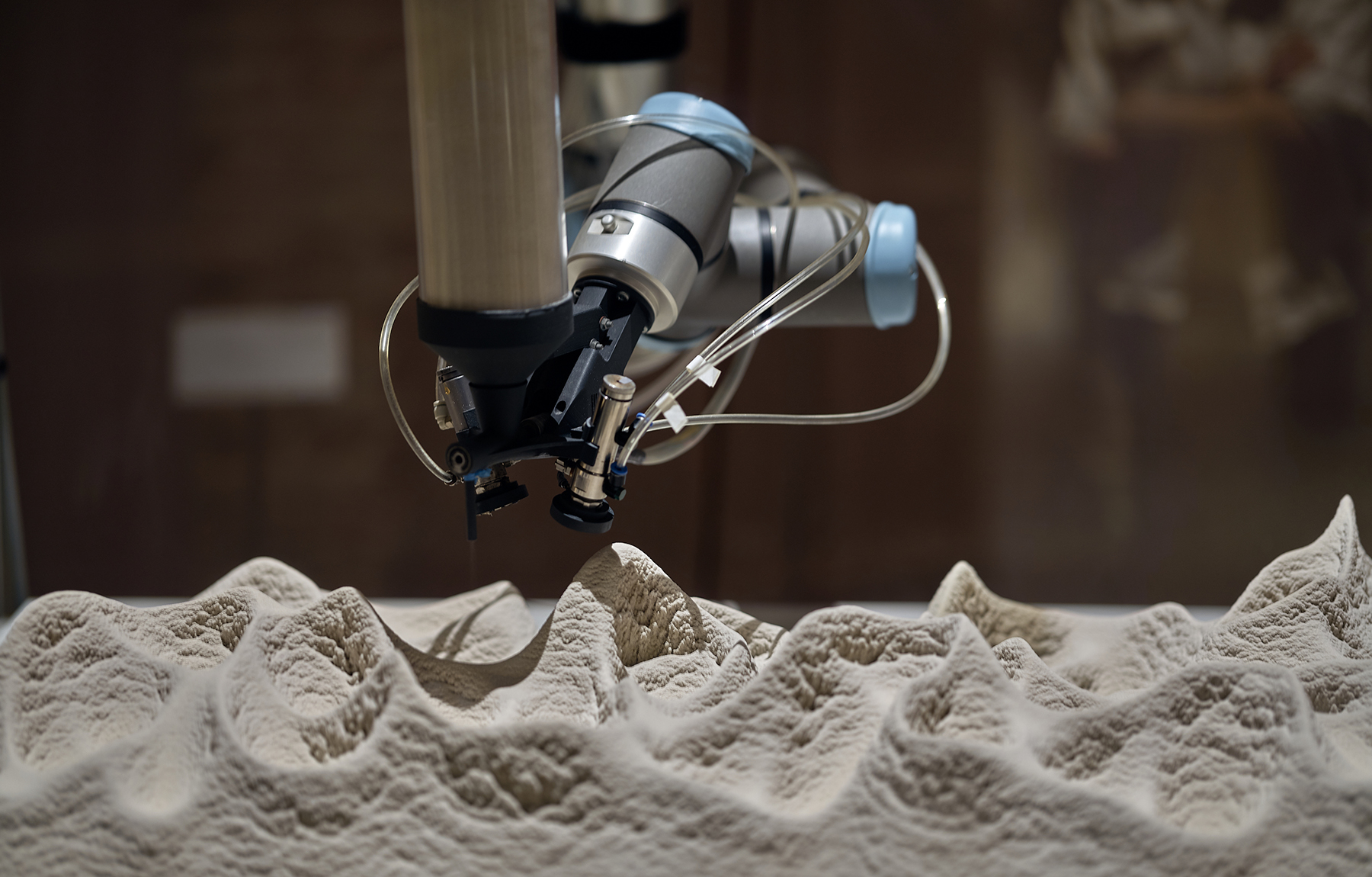
The second approach is robotic spraying. In this technique, the researchers removed the intermediate stage of the immersion bath. A robotic arm applies bacteria, the mineral substances for limestone formation and sand to a surface repeatedly, building it up layer by layer.
“The printing is geared more towards architectural elements, while the spray process is more designed for surfaces,” Antorveza Paez said.
The spray process requires more research into its mechanical properties, such as how the grains and bonding medium are arranged inside the object, she added.
“I’m fascinated by the fact that nature has found ways of manufacturing very sophisticated materials and that we can make these applicable to the problems we face today,” she said, adding: “The big question is no longer whether biocement works, but rather how well its properties can be managed.”
Subscribe to our newsletter here to receive construction news and insights from around the world straight to your inbox.