













Design is underway at Viva Mundo, the world’s first football-focused theme park, a €450m, 80ha development located in the southern Portuguese municipality of Santarém.
Due to be completed by 2030 to coincide with Portugal hosting the World Cup, GCR caught up with Jose Miguel Ferraz, founder and chief executive of JFA Group, who will be the main turnkey provider for the project.
Describe JFA Group’s role in terms of developer and EPC delivery, and any project challenges it may face on the project.

JFA Group is responsible for leading the integration, planning, design, engineering, procurement and construction delivery strategy required to complete Viva Mundo.
JFA Group signed the project agreement approximately one year ago. Since then, feasibility studies have been carried out, the project has progressed into the design phase and the masterplan has been submitted to the relevant local entity for the Portuguese planning and licensing phase.
The main challenges are linked to the scale and uniqueness of the development. Viva Mundo is not a conventional theme park and not a standard real estate project. It combines attractions, sport, entertainment, tourism, culture, education, hospitality, public realm, mobility, infrastructure and long-term operational requirements.
Therefore, the key challenges include multidisciplinary coordination, licensing, infrastructure integration, phasing, procurement of specialised attractions and technologies, programme control, sustainability, cost management, and ensuring that the final project remains coherent as both a visitor destination and a long-term urban asset.
How will JFA Group manage the engineering and construction planning required for such a large-scale development?
For a development of this scale and complexity, the key principle is to avoid treating design, procurement and construction as separate isolated phases. Instead, JFA Group is structuring the project around an integrated delivery model, where engineering decisions, construction methodology, procurement strategy, phasing, infrastructure requirements and operational needs are coordinated progressively during the design phase.
The current programme foresees the full design being completed by January 2027, when the construction licences are expected to be issued. Construction works and procurement are expected to begin in February 2027.
The project has also been submitted to the Portuguese trade and investment agency as part of the process for recognition as a project of national interest by the government. This reflects the project’s importance in terms of investment, tourism, employment, regional development and international visibility for Portugal.
How will Viva Mundo combine football, entertainment, culture, education and the urban environment into a cohesive experience?
Viva Mundo is being developed as an integrated destination experience where football is the central narrative, but not the only function of the project. The objective is to translate football from a purely sporting activity into a wider visitor journey combining entertainment, culture, education, technology, hospitality, public realm and urban experience.
From a planning and design perspective, the project is being structured around the concept of a coherent visitor journey. This means that the different components of Viva Mundo are not being treated as isolated attractions, buildings or public spaces, but as interconnected parts of one destination ecosystem. The masterplan, pedestrian flows, landscape, public realm, attraction zones, hospitality areas, education spaces, event areas, service routes, infrastructure and operational support systems must all work together to create a continuous and intuitive experience.
The football theme will be expressed through multiple layers. At one level, it will provide entertainment through immersive attractions, interactive experiences, events and family-oriented activities. At another level, it will provide cultural and educational content, presenting football as a global language connected to history, communities, identity, teamwork, performance, innovation and social inclusion. This is important because the ambition is not to create only a theme park, but a destination where visitors can understand and experience football as a cultural and emotional phenomenon.
Technically, this requires close coordination between differing focuses, such as architecture, urban design and crowd management. The experience must be attractive for tourists and families, but also efficient, safe and manageable from an operations and maintenance perspective.
The urban environment is also a key part of the concept. Viva Mundo is intended to operate not as an isolated gated attraction, but as a destination connected to Santarém and its wider regional context. This relationship with the city must be considered from the beginning. The objective is to create a project that attracts international visitors while also generating value for the local community and regional economy.
How is the €450m investment being broken down in terms of spending?
At this stage, the detailed investment can not be disclosed publicly. This is because the project is still in the design, licensing and procurement preparation phase, and several components remain subject to final technical definition, market engagement, supplier input, procurement strategy and approval procedures.
The investment is being structured around the principal components required for a large-scale destination development of this nature. These include land development, masterplanning, design and engineering and infrastructure.
What can be confirmed is that the investment is intended to support not only the construction of physical assets, but the creation of a complete international destination.
Please describe Viva Mundo’s attractions and its six areas.
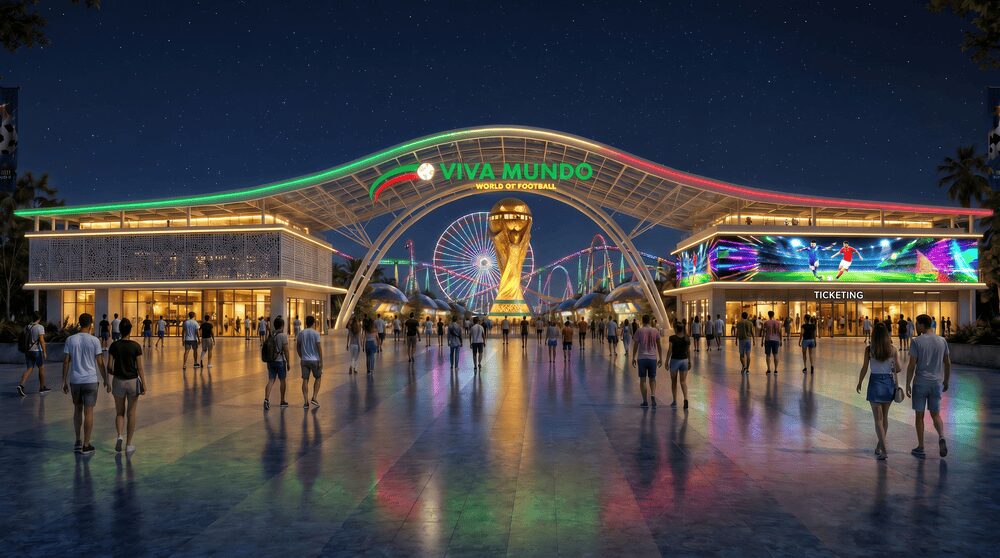
Visitors will first encounter the Welcome Gate, which contains operational functions such as ticketing, guest services, access control and security.
A heritage and retail area follows, celebrating the history of football and includes a museum, women’s walk of fame, theatre and retail and food outlets.
There will be an E-Sports Arena, which will be a flexible venue able to operate both as both a theme park experience and an independent event facility.
The Celebration District will contain a fan zone, entertainment zone and performing arts venue.
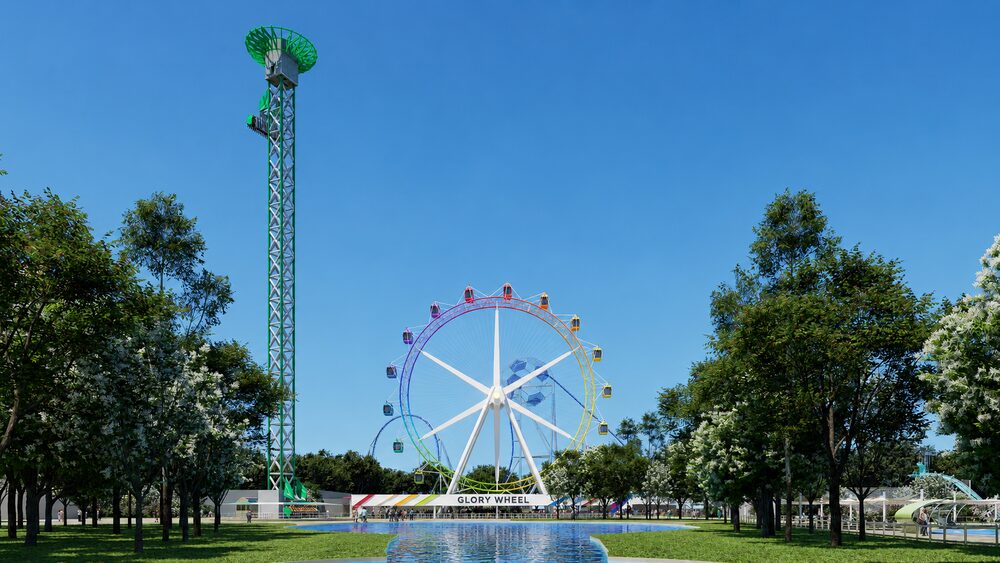
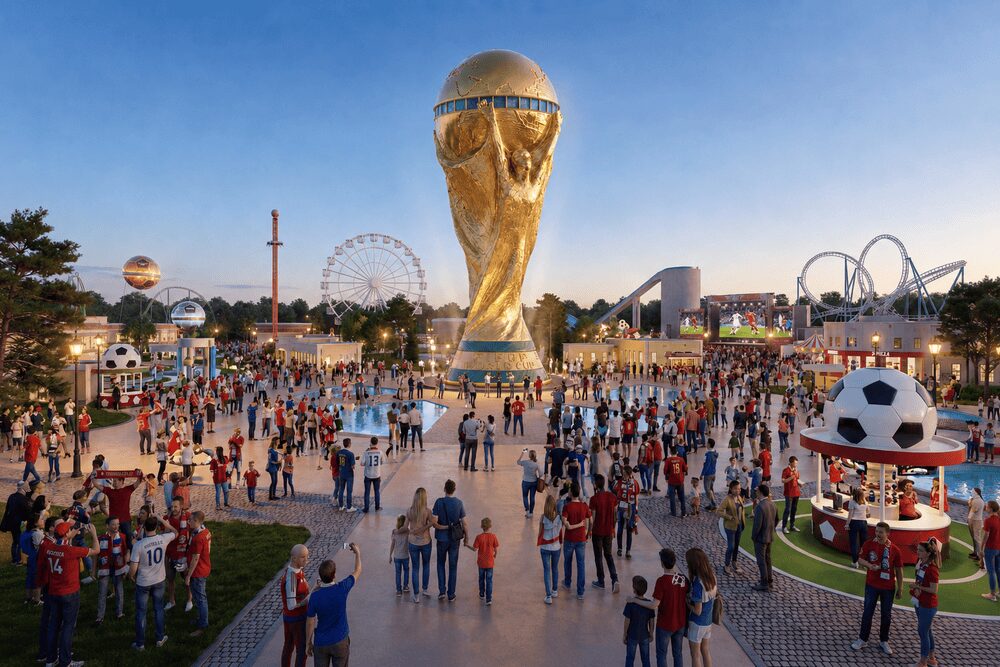
Football World will be the largest area of the park, with a lake, world cup tower with observation deck, rotating restaurant and exhibition space, multiple rollercoasters, a carousel, water rides, drop tower and go karting.
A final section will be dedicated to hotels with a total of 300 rooms and hospitality spaces.
Will the project be part of the 2030 FIFA World Cup?
At this stage, the project should be described as aligned with the 2030 World Cup legacy and Portugal’s role as a host country, rather than as an official FIFA World Cup project.
Negotiation and discussions are currently ongoing regarding potential protocols and agreements with Portugal’s football federation, UEFA and FIFA.
How will Viva Mundo be integrated into the surrounding historic area of Santarém?
From the beginning, the masterplan has been developed with attention to the relationship between the project, the city, the landscape and the surrounding territory, with the project site and layout being studied in relation to existing topography, access conditions and planning constraints.
These factors are essential to define where the main theme park areas, hotel, parking zones, service routes and technical areas should be located.
A key part of the integration strategy is mobility and visitor management. Viva Mundo is expected to attract national and international visitors, especially during peak seasons and major events. For that reason, the project must be planned with controlled arrival and departure flows, clear access hierarchy, adequate parking and shuttle systems, separation between visitors, staff, logistics and emergency routes and the ability to manage different operating scenarios, including normal days and event days.
In economic and urban terms, Viva Mundo is intended to operate as a catalyst rather than an isolated attraction. The project can support hotel demand, tourism flows, local services and employment.
- Subscribe to our newsletter here to receive construction news and insights from around the world straight to your inbox
Further Reading: