











Just before Christmas, the Trump administration renewed its attack on major offshore wind schemes. One is 87% complete. Developers are fighting back.
Two major offshore wind developers, Ørsted and Equinor, have sued the Trump administration to challenge its late-December suspension of all five big wind schemes under construction off the eastern US coast.
The order to halt work immediately came on 22 December from the Department of the Interior, pausing the leases for all the offshore wind projects on grounds of national security.

The department cited security risks identified in “recently completed classified reports” as well as previous unclassified reports which the department said showed “the movement of massive turbine blades and the highly reflective towers create radar interference called ‘clutter’.”
“The clutter caused by offshore wind projects obscures legitimate moving targets and generates false targets in the vicinity of the wind projects,” the department said.
The pause is for 90 days but the department reserved the right to extend it.
Decades of planning and billions spent
The five suspended projects are Ørsted’s Revolution Wind and Sunrise Wind; Equinor’s Empire Wind 1; Vineyard Wind 1, a joint venture of Copenhagen Infrastructure Partners and Avangrid; and Dominion Energy’s Coastal Virginia Offshore Wind.
All schemes are fully permitted and, combined, represent decades of planning and billions of dollars already invested.
Both Ørsted and Equinor said the lease suspensions were unlawful.
Power this month
Ørsted said Revolution Wind is 87% complete and was expected to start generating electricity this month. The project is set to power some 350,000 homes this year under 20-year power purchase agreements with utilities in Connecticut and Rhode Island.
When the stop-work order came on 22 December, all offshore foundations had been built and 58 of 65 wind turbines had been installed, the company said.
On 1 January, Revolution Wind LLC, a 50/50 joint venture between Ørsted and Skyborn Renewables, filed a supplemental complaint in the US District Court for the District of Columbia challenging the lease suspension. A motion for a preliminary injunction would follow, Ørsted said.
The company said the scheme secured all required federal and state permits in 2023 after nine years of project reviews in consultation with the Military Aviation and Installation Assurance Siting Clearinghouse, an agency of the US Department of Defense, which the current administration refers to as the “Department of War”.
‘Fully executed agreement’
“Those consultations resulted in a fully executed formal agreement between the Department of War, the Department of the Air Force, and Revolution Wind outlining mitigation measures by the Project,” Ørsted said.
The Interior Department first tried to suspend Revolution Wind in August last year, but work resumed after the developers successfully sued for a preliminary injunction against the stop-work order the following month.
Some $5bn worth of private investment has already gone into Revolution Wind.
Empire strikes back, again
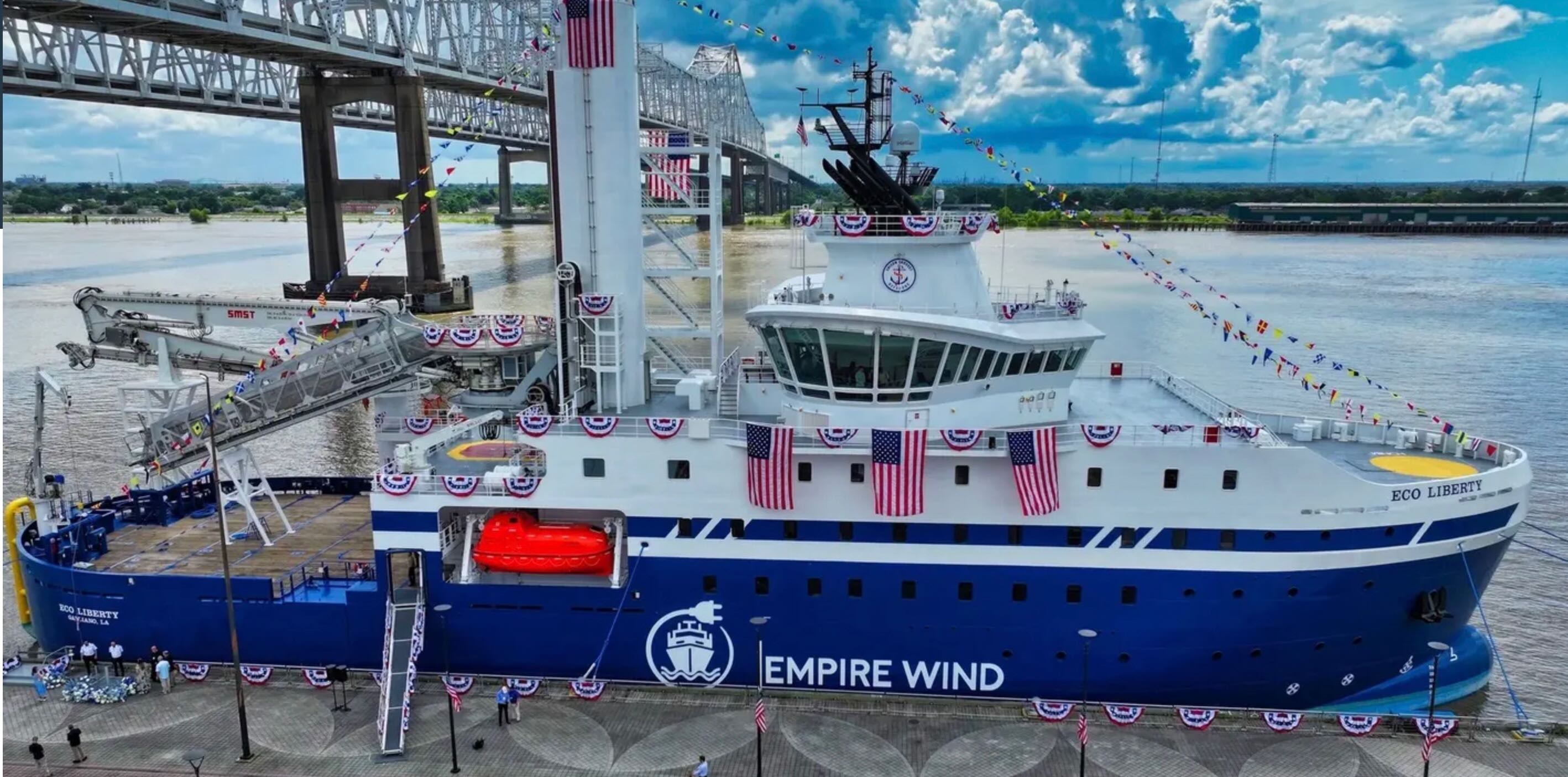
Empire Wind 1, developed by Norway’s Equinor, is 60% complete off the coast of New York State.
By 2027, its 54 turbines were expected to generate 810MW to power 500,000 homes.
The project involves an $861m rehabilitation of the 73-acre South Brooklyn Marine Terminal. Skanska won the contract for that project in April 2024.
In response to the latest stop-work order, on 2 January, Empire Offshore Wind LLC filed a civil suit in the US District Court for the District of Columbia, saying it would also seek a preliminary injunction.
$4bn spent so far
Equinor says it has spent $4bn on the scheme so far, of which $2.7bn has been drawn under the project financing.
Equinor said in a statement: “Empire has coordinated closely with numerous federal officials on national security reviews since it executed its lease for the project in 2017, including with the Department of War, and has complied with relevant national security related requirements identified as part of the regulatory process. In addition, Empire meets regularly with officials charged with oversight of security issues for the project, including weekly meetings with the US Coast Guard and other marine first responders.”
The Interior Department first tried to stop Empire Wind in April last year, but reversed its attempt after intense lobbying by New York State governor Kathy Hochul and Norwegian finance minister and former Nato Secretary General, Jens Stoltenberg.
- Subscribe here to get stories about construction around the world in your inbox three times a week