














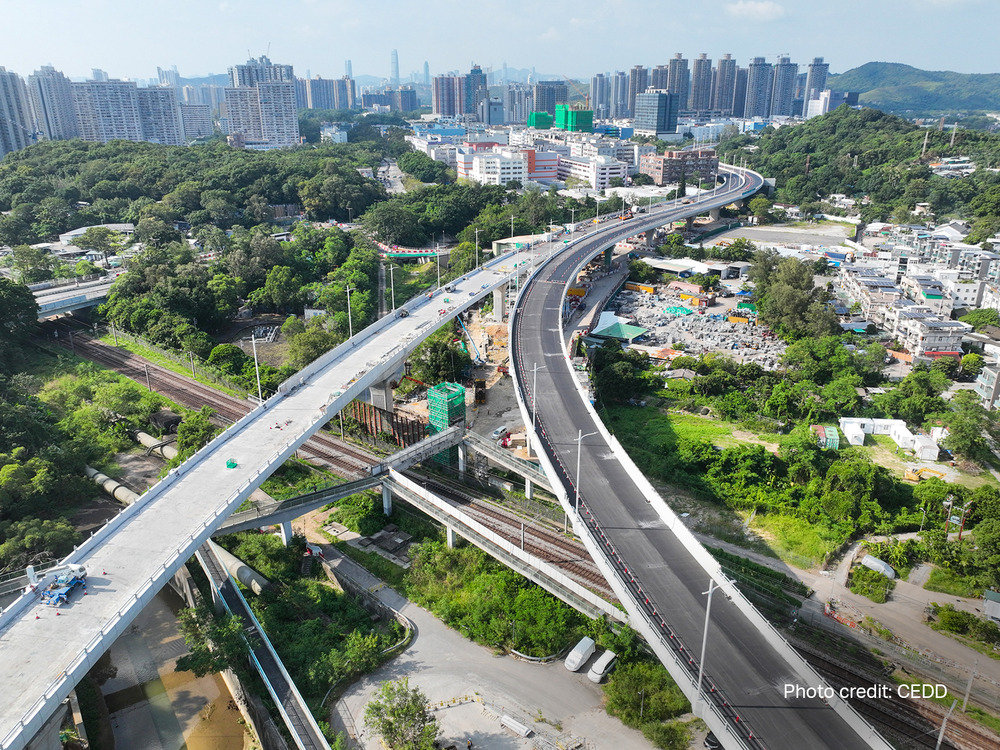
Aecom has finished the 4km-long eastern section of the Fanling Bypass, the first major transport project delivered in Hong Kong’s Northern Metropolis, which will connect Hong Kong with Shenzhen and the Greater Bay Area.
Innovations on the job included Hong Kong’s first horizontal bridge rotation, which saw a 140m-long, 7,000-ton bridge built next to its final location and installed into position over a single night to minimise disruption to rail operations.
Aecom said it cut construction time by approximately 12 months.

Precast bridge deck segments were fabricated on the Chinese Mainland and installed using launching girders and mobile cranes.
To prepare for the lift, digital tools such as Building Information Modelling, LiDAR, AI-enabled CCTV and automated deformation monitoring were used.
A 4D BIM model enabled progress monitoring and helped identify potential issues early, reducing risk by an estimated 70%.
The site was hampered by large diameter watermains, high voltage underground power cables and an existing footbridge.
The road links the Fanling North New Development Area to Fanling Highway, aiming to reduce congestion in Fanling town centre and travel times during rush hour by 10 minutes.
Two new footbridges were also inaugurated, including Footbridge F6 which spans the Lung Yeuk Tau Interchange.
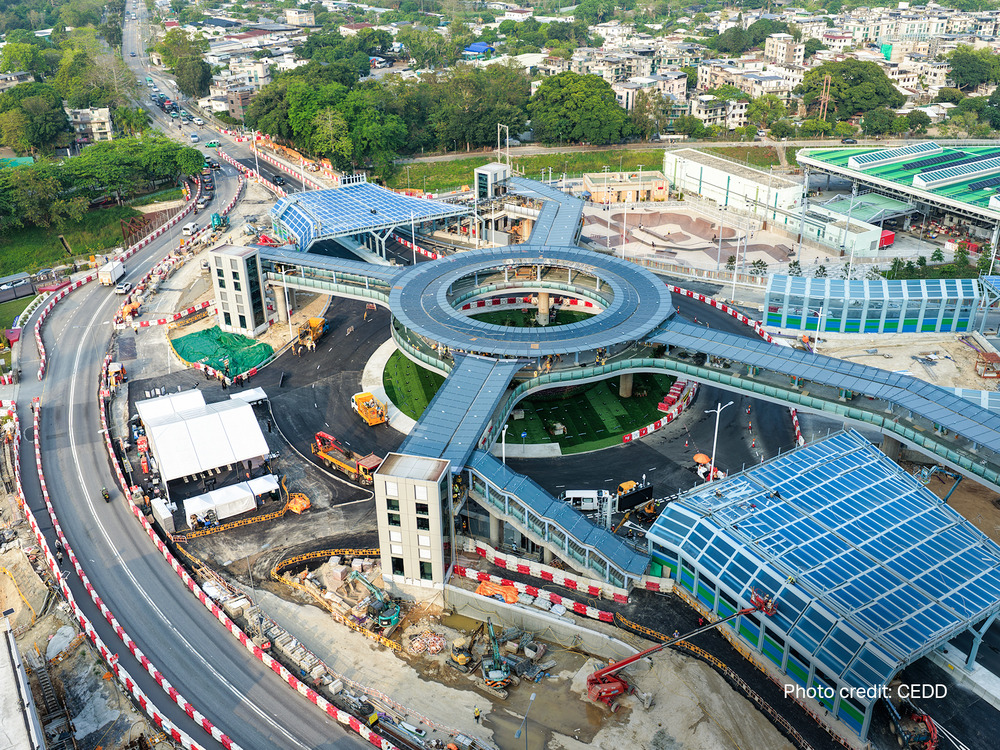
It’s the first structural application of S960 steel, nearly three times the strength of conventional structural steel. Aecom said it reduced the structure’s weight by nearly 90%.
Robotic welding technology was used for the S960 steel components to improve precision and productivity.
Dr. Johnny Cheuk, Aecom’s executive leader in Hong Kong, said: “This milestone demonstrates the power of collaboration across government, industry, academia and research.
“We are proud to contribute to a project that reflects Hong Kong’s Construction 2.0 vision while supporting the nation’s 15th Five-Year Plan, bringing advanced engineering solutions and high-quality ‘Made in China’ materials to both Hong Kong and the global stage.”
- Subscribe to our newsletter here to receive construction news and insights from around the world straight to your inbox
Further Reading: