














This week saw the sinking of the first concrete section of the 18-km-long Fehmarnbelt tunnel linking Germany and Denmark, which claims to be the world’s longest immersed combined road and rail tunnel.
The precast section, 217m long and weighing 73,500 tonnes, contains two road tubes, two rail tubes, and a service tunnel.
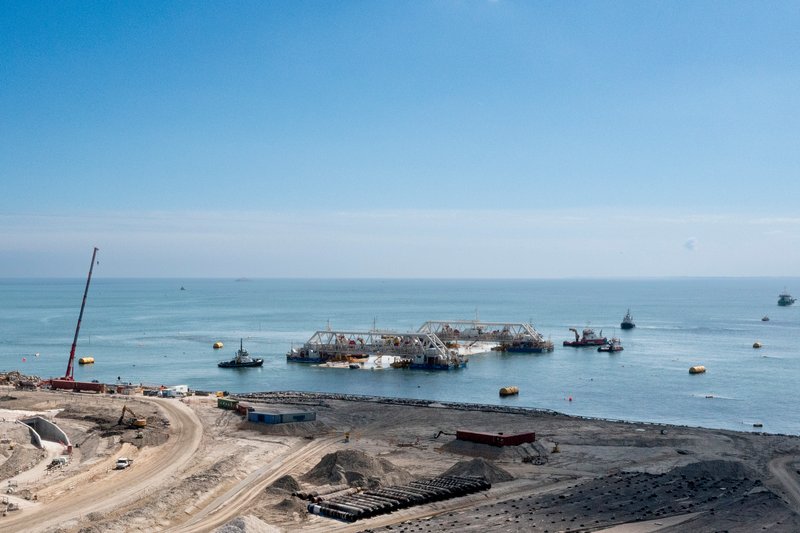
The days-long operation starting 4 May saw five tugboats pull the section just over 2km from the fabrication hall into place for submersion at the future tunnel portal on the Danish island of Lolland.

The section was attached to a vessel built to immerse the element down onto the seabed.
4,500 tonnes of ballast concrete were added to the section to make it sink into place in an 18km-long trench prepared on the seabed with a layer of gravel laid to ensure it rests in the correct position.
The section is sealed at both ends and filled with air except for the narrower and therefore lighter railway tubes, the outer one of which was filled with temporary water chambers to make the tunnel fall evenly into the trench.
“It is a major task with very little margin for error,” said Lasse Vester, a deputy contract director at the project’s developer, state-run Sund & Bælt.
“We have to immerse an element that is as long as two football pitches, within just a few millimetres.
“That places great demands on the equipment and on our contractor, which is why they have been preparing for this task for a long time.”
It was recently announced that real estate company Verdion would build a €1bn business and logistics district in the city of Ringsted on the Danish island of Zealand, close to the Fehmarnbelt tunnel.
- Subscribe to our newsletter here to receive construction news and insights from around the world straight to your inbox
Further Reading: