











The method is intended for technically complex projects where the project owner isn’t sure how to achieve the outcomes it wants.
Poland’s transport megaproject, “Port Polska”, says it will be the first in Central and Eastern Europe to use the “competitive dialogue” method to procure a section of high-speed rail. Contractors have until 2 March to apply to compete in the process.
Competitive dialogue was introduced in the EU in 2004 for the public procurement of technically complex projects where the project owner isn’t sure how to achieve the outcomes it wants. The method lets the owner enter structured dialogues with selected parties to explore solutions before picking the one it likes best.

The job will be to design and build a 13km stretch of line between Kotowice on the western outskirts of Warsaw and the new international airport junction farther west.
The line will have to be designed for trains running at speeds of up to 350km/h – including gradients, curve radii, and turnouts – with a traction power supply standard of 25 kV AC. This is new for Poland, which currently uses 3 kV DC.
The body delivering Port Polska, Centralny Port Komunikacyjny (CPK), will invite six contractors to enter the process. The winner will be responsible for detailed design and construction.
“We are counting on the participation of Polish companies so that the investment becomes a stimulus for the domestic economy,” said Maciej Lasek, CPK’s government plenipotentiary.
National transport overhaul
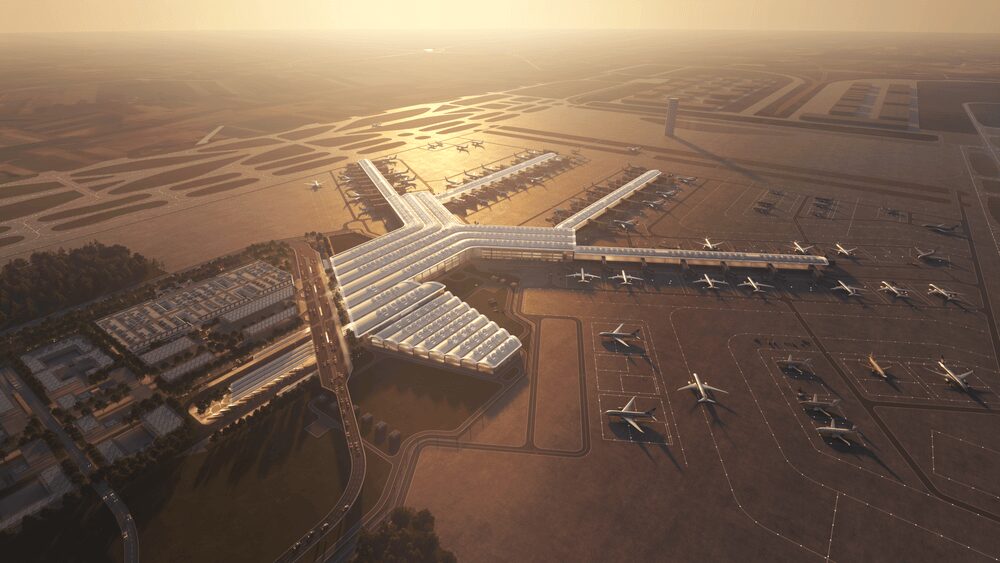
Port Polska is an ambitious overhaul of Poland’s transport network, centering on a new international airport sited some 50km west of Warsaw, highway upgrades and 2,000km of high-speed rail.
The goal is to bring all major Polish cities to within 2.5 hours’ travel time of the new Foster + Partners and Buro Happold-designed airport, scheduled to open in 2032.
The section of line being procured now is part of a Y-shaped fast railway going from Warsaw to the airport and continuing west through Łódź to Sieradz, where it will split, with one line continuing northwest to Poznań and the other going southwest to Wrocław.
Poland’s deputy infrastructure minister, Piotr Malepszak, said that up to 20% of long-distance rail passengers in the country will use this route.
“From a transport perspective, this investment will bring Poland into the premier league of the world’s developed rail nations,” said Piotr Rachwalski, CPK board member responsible for rail.
He added that this use of competitive dialogue is a prelude to five more Port Polska rail contract awards this year.
- Subscribe here to get stories about construction around the world in your inbox three times a week
More on Port Polska: