














Project in Colombia shows how the technology can be used to build in remote areas.
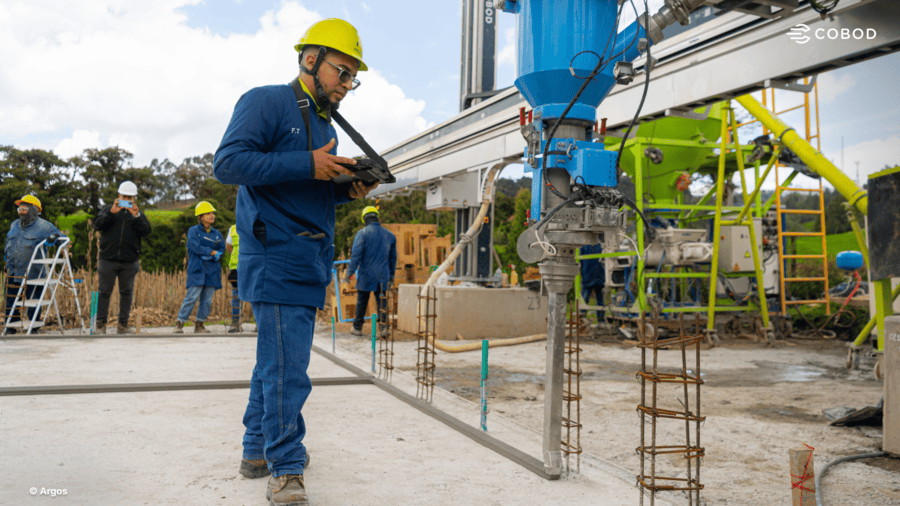
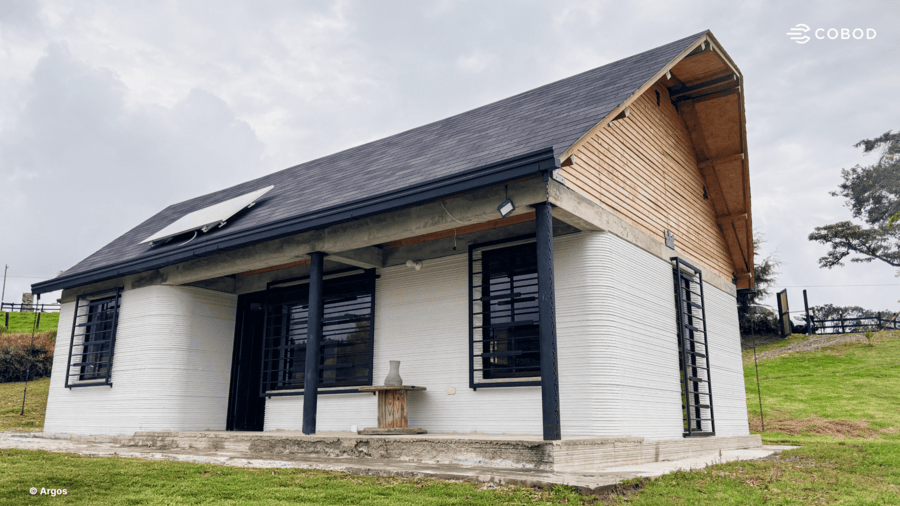
South America’s first 3D printed social housing has been completed in La Unión, in Colombia’s western Antioquia department, with walls printed by Colombia’s Cementos Argos using Cobod’s Bod2 printer on behalf of non-profit Fundación Berta Martínez.
The two single-story houses each have a 63-sq-m floorpan. They were printed on site in 16 hours over three days. Cobod described the process as 30% faster than traditional building techniques, with 15–30% less waste and 20% lower material costs.

Each home has two bedrooms, a living room, kitchen, bathroom, laundry area and porch, 2.2m-high walls and a timber roof.
Tailored mixing
Cobod’s proprietary printers work with a variety of mixes. Cementos Argos’ custom mortar mix for this project contained 99% locally sourced raw materials. The walls’ compressive strength exceeds 35 MPa (5,076 psi).
The structural design, approved by a Municipal Planning Office, complies with local seismic resistance standards.
Daniel Duque, R&D director of Cementos Argos, said to GCR: “The dry mix contains fibres and chemical additives that provide resistance to plastic shrinkage stresses, preventing cracking caused by wind, humidity and temperature fluctuations in the region.”
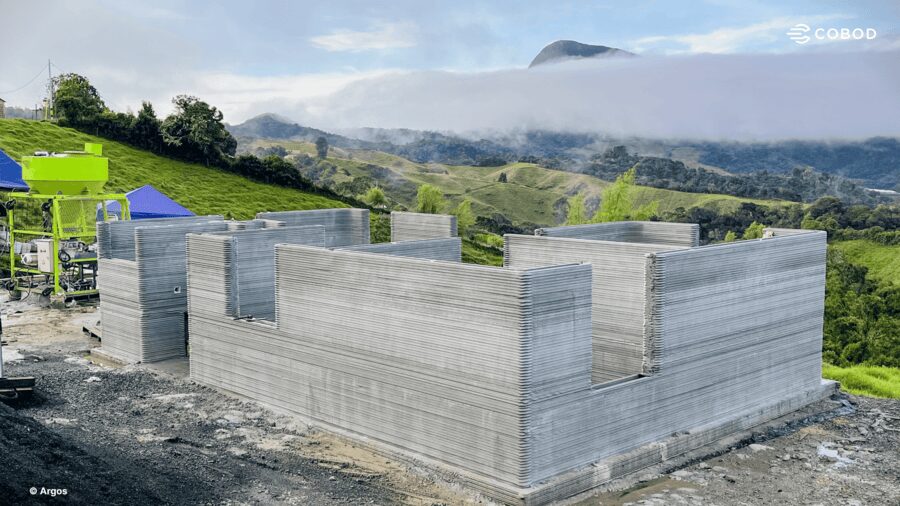
Tests were undertaken across several months to determine the mechanical properties of the material, adhesion between layers, the curing process and the structural behaviour of the printed walls.
Duque commented on the structure: “The design of this project is notable for its flexible interior layout and the potential for future lateral expansion of the house.
“Due to the double-walled printed walls, with an intermediate air chamber, the walls generate thermal insulation, improving comfort inside the house.”
Up the mountain
The printer was transported in five small trucks in mountainous terrain and heavy rains.
Speaking to GCR, Philip Lund-Nielsen, Cobod’s co-founder, said: “A crew of three to four people can operate the printer continuously, removing a major bottleneck.”
The technology can be used in conjunction with traditional construction techniques.
Scalability
Commenting on the scalability of the technology, Duque said that a relatively low capital investment would allow construction companies to build within a reasonable rate and timeframe, with transport and installation costs also reduced.
Lund-Nielsen said: “Typically, 3D printing addresses up to one third of total construction cost by handling the wall systems, both interior and exterior, and sometimes the foundations. Other contractors manage roofing, MEP, and finishing.”
Future plans
Speaking on future projects, Duque said: “We are structuring a project for 20 clustered social housing units, which will allow us to scale the technology and optimise the structural and architectural design, as well as the printing process, to make this technology economically viable.
“In this case, we will use the equipment to print walls off-site, which will then be transported and assembled at the construction site. This alternative reduces installation costs of the printer, as it eliminates the need to install the equipment multiple times, but it does require optimising the handling of the load on-site.”
Philip Lund-Nielsen, said: “Several of our customers are actively working on social and affordable housing projects across multiple regions, and Cementos Argos has indicated they are evaluating further rural housing applications in Colombia using this technology.”
Lund-Nielsen also commented on expanding Cobod beyond wall printing: “We are working to automate additional on-site tasks such as spray-painting walls and insulation, in the future.”
- Subscribe to our newsletter here to receive construction news and insights from around the world straight to your inbox
Further Reading: